
The story of Airbnb isn’t a tale of Silicon Valley geniuses sitting in a lab trying to “disrupt travel.” It’s a story of two broke guys in a San Francisco apartment who couldn’t pay their rent.
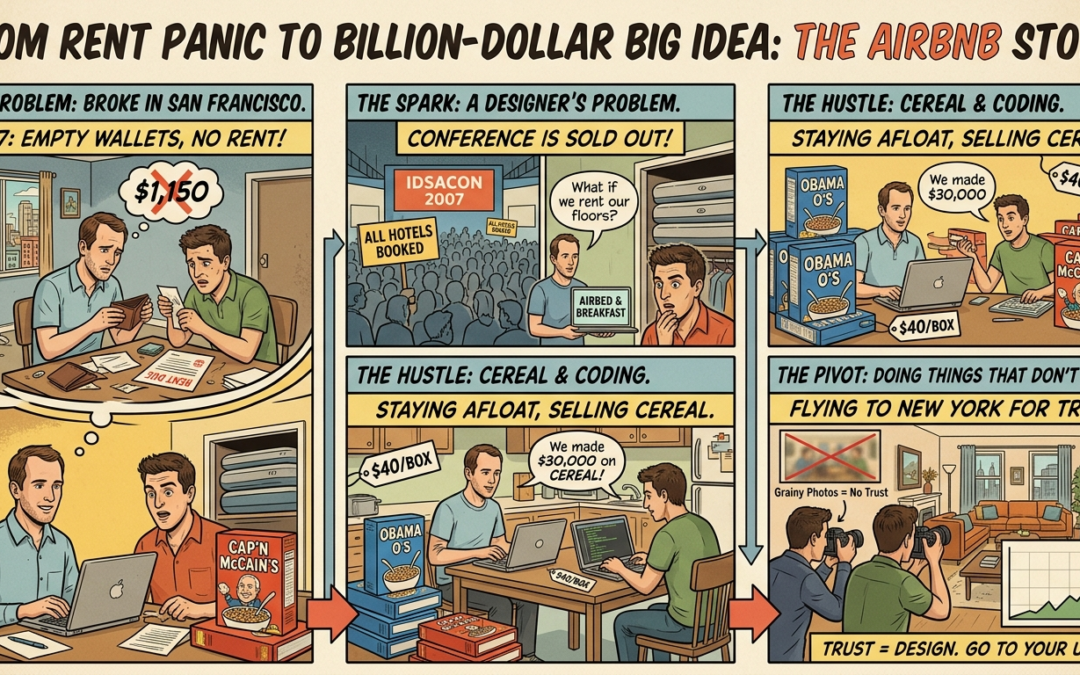
In 2007, Joe Gebbia and Brian Chesky were staring at a problem that millions of young people face: $1,150 due at the end of the month and an empty bank account.
The Spark: A Sold-Out City
That same week, the Industrial Design Society of America was holding a massive conference in San Francisco.
Joe saw the problem—not just their own lack of cash, but the hundreds of designers who had nowhere to sleep.
“I thought of a way to make a few bucks. Let’s turn our place into a ‘designers’ bed and breakfast.’ We’ll offer a place to sleep, WiFi, a workspace, and breakfast!”
The Catch: They didn’t have any spare beds. They did, however, have three air mattresses in the closet.
The Experiment: AirBed & Breakfast
They set up a simple website—Airbedandbreakfast.com—and charged $80 a night.
They didn’t just give them a place to sleep; they gave them a local experience. They acted as tour guides, shared breakfast, and saw something the hotel industry had forgotten: People aren’t just looking for a room; they’re looking for a connection.
They made $240, paid their rent, and realized they were onto something huge.
The Struggle: Cereal and Rejection
Despite the successful experiment, the “real world” hated the idea. Investors thought the concept of strangers sleeping in each other’s homes was creepy and dangerous. Brian and Joe were drowning in credit card debt.
To stay afloat, they resorted to a legendary “hustle.” During the 2008 election, they designed and sold custom cereal boxes: “Obama O’s” and “Cap’n McCain’s.” They made $30,000 selling cereal, which essentially funded the early days of Airbnb.
Fun Fact: When they finally got into the Y Combinator accelerator, founder Paul Graham famously said, “If you can convince people to pay $40 for a $4 box of cereal, you can probably convince them to sleep in each other’s beds.”
The Pivot: Doing Things That Don’t Scale
By 2009, the site was still struggling.
They realized their New York listings looked terrible because the photos were grainy and dark.
The result? Bookings doubled in a week. They learned that in the sharing economy, Trust = Design.
The Lesson for SMEs
Airbnb wasn’t born from a “billion-dollar idea.” It was born from:
-
A personal pain point (Not being able to pay rent).
-
A market gap (Sold-out hotels).
-
The courage to be “weird” (Renting out air mattresses).
The takeaway: Don’t look for the “next big thing.” Look for a small, annoying problem that people are willing to pay $80 to solve today. The billion-dollar scale usually comes after you’ve manually solved the problem for the first three people.