
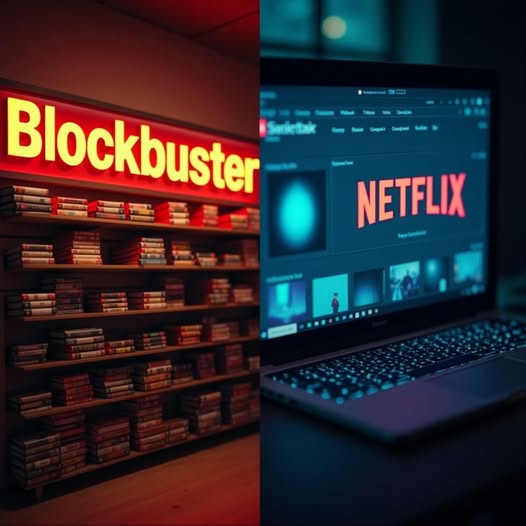
As we look at the market landscape from 2024, the lessons from the Blockbuster collapse resonate louder than ever. It’s a tale of a billion-dollar giant that saw the future, blinked, and paid the ultimate price.
This post will analyze exactly how Blockbuster failed and identify the critical strategic moves that allowed Netflix to not just rise, but to utterly redefine an entire industry.
Part 1: Blockbuster’s High-Margin Peak (and Why It Was Fatal)
In the late 1990s, Blockbuster was the undisputed king of home entertainment. It had nearly 10,000 stores globally and controlled a staggering portion of the rental market. But its dominance built a castle on a foundation of customer frustration.
The Strategic Flaw: Relying on “Bad Profits”
Blockbuster’s business model was optimized for a single, lucrative metric: Late Fees. At its peak, late fees accounted for as much as 16% of their total revenue—a stunning $800 million per year.
While profitable, these were “bad profits.” They were derived from customer annoyance. Blockbuster made money when its customers failed. This created zero loyalty.
Part 2: 1997–2003: The David vs. Goliath Era
When Reed Hastings founded Netflix in 1997, it was a joke to Blockbuster executives. But Hastings saw three crucial things that Blockbuster ignored:
DVD Technology: VHS was bulky, but DVDs were light, thin, and could fit in a standard envelope. They were perfect for the mail.
A Subscription Model: Netflix removed the friction of rentals. Instead of pay-per-tape + penalty, it offered a flat monthly fee for unlimited rentals.
No Late Fees: Netflix erased the single biggest customer pain point that Blockbuster relied upon for revenue.
The Turning Point: The Infamous 2000 Meeting
In 2000, Netflix was bleeding cash. A struggling Hastings met with Blockbuster’s then-CEO, John Antioco. Hastings offered to sell Netflix to Blockbuster for $50 million. Blockbuster would handle the physical stores; Netflix would manage the online, mail-order business.
Antioco allegedly “laughed them out of the room.”
Blockbuster saw Netflix’s mail-order business as a niche, low-margin distraction. Why pivot to a new, unproven digital model when the physical stores were still printing money (from late fees)? This complacency was their single biggest mistake.
Part 3: Why Blockbuster Really Failed
It wasn’t that Blockbuster was oblivious to technology. They did eventually try to innovate. They created “Blockbuster Online” to rival Netflix’s mail service. By 2006, it was actually gaining significant traction.
So why did they still collapse into bankruptcy by 2010?
Too Little, Too Late: Blockbuster didn’t launch its online service until 2004—seven years after Netflix. By then, Netflix had captured the data, optimized the logistics, and built the brand trust.
Cannibalization Fear: In 2007, a new Blockbuster CEO took over, concerned that the growing (and unprofitable) online division was cannibalizing the highly profitable physical stores. He killed Blockbuster Online’s growth initiatives, focusing instead on bringing customers back to the retail counters. It was a retreat back to the old model.
Data Blindness: Blockbuster Online was managed as a separate business unit. Blockbuster corporate couldn’t see the single customer view. Netflix, from day one, built a recommendation algorithm (Cinematch) that understood user behavior better than the user did. While Blockbuster knew what a store rented, Netflix knew exactly what individuals wanted to watch.
Summary: The Strategic Takeaways for 2024 Leaders
Blockbuster didn’t fail because people stopped watching movies. They failed because the way people consumed movies evolved, and Blockbuster refused to evolve its revenue model.
Key Lessons for Any Business:
Innovate on Customer Pain, Not Competitor Tech: Netflix won by eliminating late fees, not by using better envelopes.
The Sunk Cost Fallacy is Real: Don’t double down on an obsolete asset (stores) just because you invested billions in it.
Never Rely on “Bad Profits”: If your profit comes from user frustration, you have a competitor-shaped bullseye on your back.
The Netflix Paradox
In a twist of supreme irony, the company that began by putting DVDs in the mail now faces the exact same challenge it once posed to Blockbuster. Physical media is dead. To stay on top, Netflix had to pivot again—from a distributor of other people’s content to a massive original production studio. The lesson they learned from Blockbuster is clear: disruption is not a one-time event; it is constant.
Blog
The SME AI Revolution: 2025 Analysis & A Glimpse into 2027
The year 2025 has officially marked the end of AI being a “big tech luxury.”
How Airbnb Was Born from a Problem!
The story of Airbnb isn’t a tale of Silicon Valley