
The SME AI Revolution: 2025 Analysis & A Glimpse into 2027
The year 2025 has officially marked the end of AI being a “big tech luxury.” For Small and Medium Enterprises (SMEs), the transition from cautious observation to aggressive adoption is no longer a trend—it’s a survival mechanism.
1. The State of AI in 2025: From Experimentation to Execution
In 2025, the narrative has shifted. SMEs are no longer asking if they should use AI, but how many hours it can save them per week.
Current 2025 Benchmarks:
-
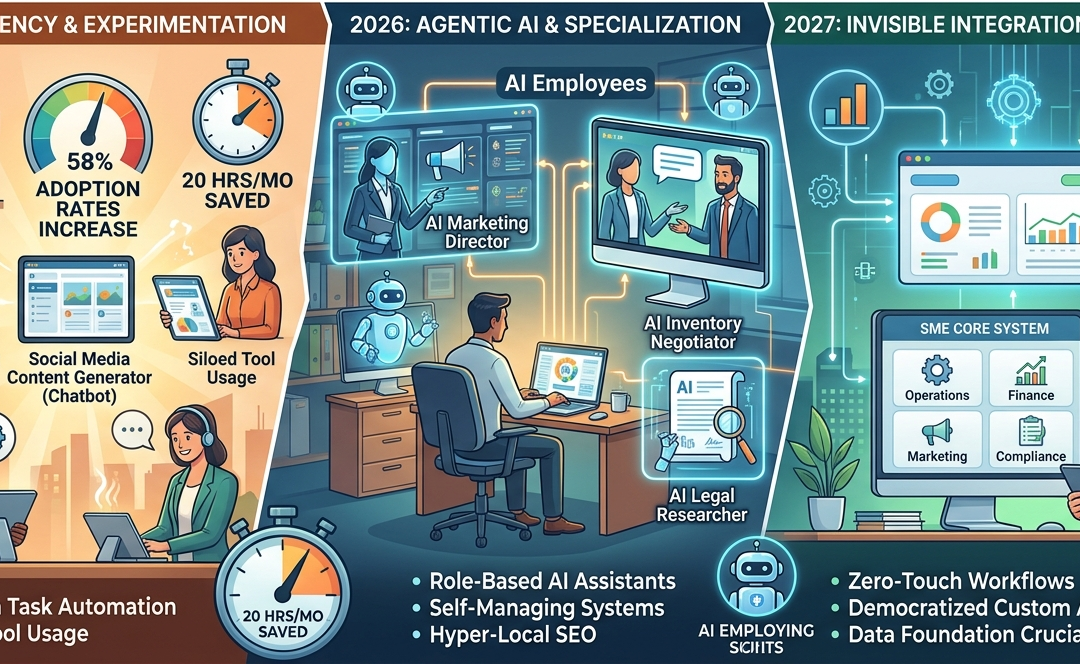
Adoption Rates: Recent data shows that nearly 58% of SMEs have now integrated generative AI into their daily operations, a massive leap from just 40% in early 2024.
-
Efficiency Gains: The average AI-forward small business is saving upwards of 20 hours per month on administrative tasks.
-
Revenue Impact: Approximately 91% of SMEs using AI report a measurable increase in revenue, driven primarily by hyper-personalized marketing and faster lead response times.
Key 2025 Use Cases:
-
Autonomous Customer Service: AI agents now handle over 50% of initial customer inquiries with human-like nuance.
-
Financial Forecasting: Small firms are using AI-driven bookkeeping to predict cash flow gaps three months in advance with 90%+ accuracy.
-
Micro-Content Factories: Marketing teams are using multimodal AI to turn a single product photo into a week’s worth of social media videos and blog posts in minutes.
2. The Next 24 Months: Predictions for 2026–2027
The next two years will move beyond simple “chatbots.” We are entering the era of Agentic AI—systems that don’t just talk, but actually do the work.
2026: The Rise of the “AI Employee”
By 2026, we expect to see “Role-Based AI Assistants” becoming standard. Instead of using a general tool like ChatGPT, a small bakery or a boutique law firm will employ specialized AI agents that:
-
Self-Manage Inventories: AI will automatically negotiate with suppliers when stock is low.
-
Hyper-Local SEO: AI will real-time monitor local search trends and update your website’s metadata daily to ensure you’re always the top result in your neighborhood.
2027: The Era of “Invisible AI” and AGI-Lite
By 2027, AI will be so deeply embedded in SME software (CRMs, ERPs, and Accounting tools) that we will stop calling it “AI”—it will just be “the software.”
-
Zero-Touch Operations: Most back-office workflows (invoicing, scheduling, and compliance) will be fully autonomous.
-
Democratized Coding: SME owners will build their own custom internal apps using natural language. If you need a custom tool to track a specific metric, you will simply describe it to your computer, and the AI will build the functional app for you.
3. Critical Barriers: What SMEs Must Navigate
Despite the optimism, the road ahead has hurdles. To stay competitive through 2027, SMEs must address:
-
The Data Readiness Gap: AI is only as good as your data. Businesses with messy spreadsheets and fragmented customer records will see “hallucinations” rather than insights.
-
The Human Element: Upskilling is the new hiring. The most successful SMEs in 2026 will be those that train their staff to be “AI Orchestrators” rather than task-performers.
-
Governance and Ethics: As AI handles more customer data, SMEs will face stricter regulations. Establishing a “Responsible AI Policy” will become as standard as having a privacy policy.
Summary: The Competitive Edge
The “wait and see” approach is officially dead. In 2025, AI is an efficiency tool; by 2027, it will be the core infrastructure of every successful small business.
Pro-Tip for SME Leaders: Don’t buy the most expensive tool; buy the one that integrates most seamlessly with your current data. Focus on fit over features, and start building your “data foundation” today.